

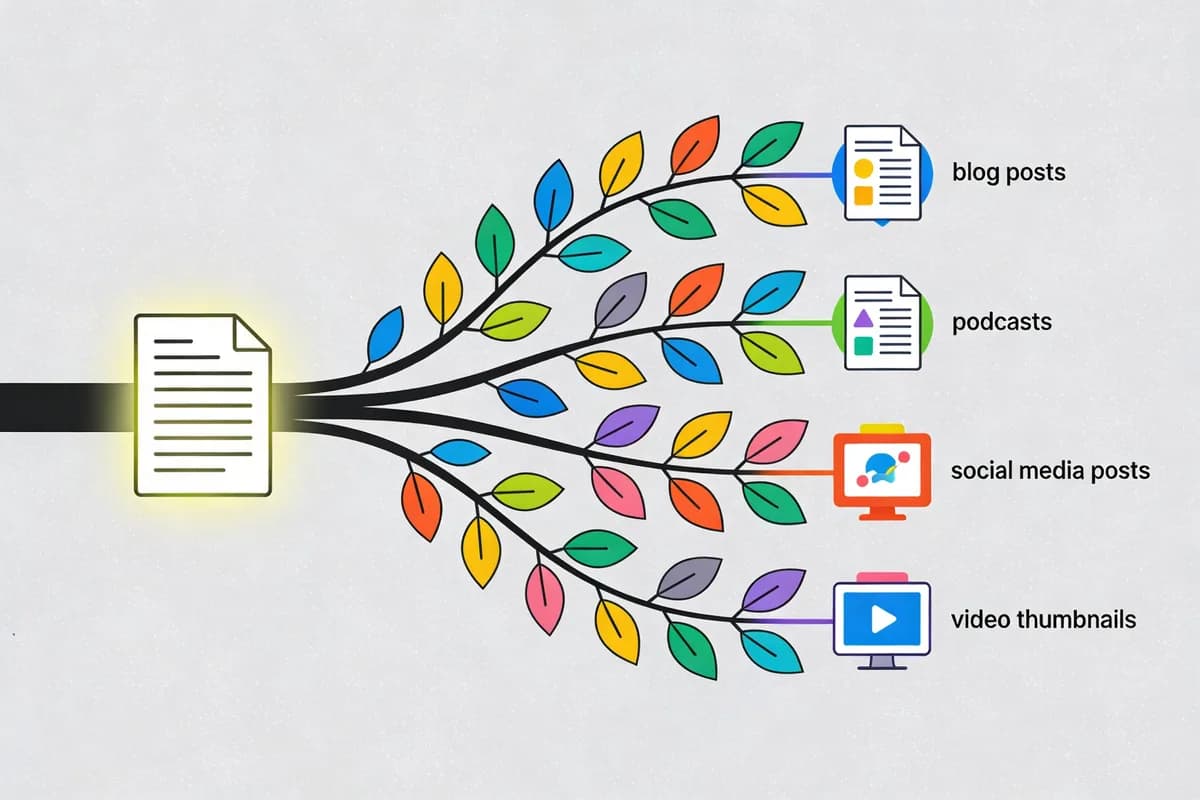
Content repurposing statistics paint a clear picture for 2026: 94% of marketers repurpose content across channels, those who do report up to 300% more reach, and repurposing saves 60-80% of creation time. The data below draws from 25+ industry sources published between 2024 and 2026, covering ROI benchmarks, engagement metrics, and time savings.
Key findings:
- 94% of marketers repurpose content for different channels and mediums -- Referral Rock survey via Intentsify
- Content repurposing can increase reach by 300% across audiences with different consumption preferences -- CloudPresent
- Repurposed content generates 25-35% more engagement than one-off posts -- Hootsuite 2026 platform analysis via InfluenceFlow
- 65% of marketers say repurposing is more affordable than creating new content -- Intentsify
- Content marketing generates $3 for every $1 invested on average -- Genesys Growth
- 60% of marketers find repurposed content generates more leads than original content -- Shno via HubSpot research
- 48% of social media marketers share repurposed content across platforms with minor adaptations -- Sprout Social 2026
What Is Content Repurposing?

Content repurposing is the process of taking one existing piece of content and adapting it into multiple formats for distribution across different channels. A single webinar recording can become a blog post, several social media clips, a podcast episode, an email newsletter, and a set of quote graphics.
This isn't the same as reposting. Repurposing means reshaping the message to fit each platform's audience and format expectations. A 45-minute video interview gets transcribed, then edited into a long-form article. Key quotes get pulled for LinkedIn posts. Data points become an infographic. The core ideas stay the same, but the packaging changes for each platform.
Why Does Content Repurposing Matter in 2026?
The math behind repurposing is hard to ignore. According to Orbit Media's blogging survey, the average blog post takes nearly four hours to write. That figure has climbed steadily over the past decade as content quality expectations have risen. Creating original content from scratch every time is expensive, whether you measure cost in hours, freelancer fees, or team bandwidth.
A Content Marketing Institute survey found that 57% of marketers say lack of resources is one of their biggest challenges. Repurposing directly addresses that constraint. Instead of producing ten original pieces per month, you can produce three strong originals and repurpose them into ten or more derivative assets.
I've seen this firsthand at TranscribeTube. When we started transcribing our own video content and turning those transcripts into blog posts, social threads, and documentation pages, our content output nearly tripled without adding headcount. That's the efficiency multiplier the data keeps confirming.
Key Content Repurposing Statistics for 2026

These headline numbers give you the full picture of where content repurposing stands today. Each stat comes from a published source, and I've included the "why it matters" context that raw numbers alone can't provide.
94% of Marketers Repurpose Content
Of 48 marketers surveyed by Referral Rock, 94% said they repurpose content for different mediums and channels. -- Intentsify
This isn't a niche tactic anymore. When nearly every marketer surveyed says they're doing it, the real question shifts from "should we repurpose?" to "how efficiently are we repurposing?" The 6% who don't repurpose are the outliers, not the norm.
What to do: Audit your last 20 pieces of content. For each one, identify at least two derivative formats you haven't created yet. Start with your highest-performing originals, because they've already proven audience interest.
Repurposing Can Boost Content Reach by 300%
Systematic content repurposing can boost your content reach by 300% by expanding visibility across audiences with different consumption preferences. -- CloudPresent
A blog post only reaches people who read blogs. A video version of that same content reaches YouTube searchers and social media scrollers. A podcast version reaches commuters and gym-goers. Each format opens a new audience segment that you'd never reach with the original alone.
What to do: Map your top 5 content pieces to the formats your audience actually uses. Check your analytics for which channels drive the most engagement, then repurpose your best content into those specific formats first.
Repurposed Content Gets 25-35% More Engagement
Repurposed content generates 25-35% more engagement than sporadic, one-off posts because it reinforces messaging across channels. -- Hootsuite 2026 platform analysis via InfluenceFlow
Repetition builds familiarity. When your audience encounters the same core message in a blog post, then again in a social carousel, and again in a short video, the message sticks. This isn't redundancy. It's strategic reinforcement across the platforms where your audience already spends time.
What to do: Build a multichannel content distribution calendar that maps each original piece to 3-4 repurposed formats, staggered over 2-3 weeks for sustained visibility.
48% of Social Marketers Already Share Repurposed Content
48% of social media marketers share similar or repurposed content across platforms with minor moderations or adaptations. -- Sprout Social 2026 Content Strategy Report
Nearly half of social media professionals are already repurposing as part of their standard workflow. The ones who do it well adapt tone, format, and length for each platform rather than copying and pasting identical content everywhere.
What to do: Create platform-specific templates for repurposing. A LinkedIn post needs a professional hook and data point. An Instagram carousel needs visual design. A Twitter thread needs punchy, numbered takeaways. Same content, different packaging.
60% of Marketers Say Repurposed Content Generates More Leads
60% of marketers find that repurposed content generates more leads than original content, based on HubSpot research. -- Shno
This stat challenges the assumption that only "fresh" content drives conversions. Repurposed content often performs better because it's built on proven ideas. You already know the original resonated. The repurposed version simply meets more people where they are.
What to do: Track lead attribution for repurposed vs. original content separately. You'll likely find that repurposed assets, especially email digests and social snippets, convert at rates equal to or higher than originals.
65% Say Repurposing Is More Affordable Than Creating New Content
65% of marketers agree that content repurposing is more affordable than creating entirely new content. -- Intentsify
When you repurpose, you skip the most time-consuming stages of content creation: research, ideation, and first-draft writing. The thinking is already done. You're adapting, not starting from zero. That's why the cost savings are significant for teams of every size.
What to do: Calculate your cost per content piece for originals vs. repurposed content. Most teams find repurposed assets cost 30-50% less per unit while performing at comparable engagement levels.
Companies With a Documented Strategy See 33% Higher ROI
Companies with a documented content strategy see 33% higher ROI than those without one. -- SQ Magazine
Having a plan matters. Teams that document their repurposing workflow, including which formats to create, which platforms to target, and which metrics to track, consistently outperform those who repurpose ad hoc.
What to do: Write down your repurposing workflow. Include triggers (e.g., "every blog post over 2,000 words gets turned into a LinkedIn carousel"), responsible team members, and deadlines. A documented process removes guesswork.
Content Repurposing ROI Statistics

ROI is where content repurposing moves from "nice to have" to a measurable business strategy. The numbers below connect repurposing efforts directly to revenue, cost savings, and return benchmarks.
Content Marketing Generates $3 for Every $1 Invested
Content marketing generates $3 for every $1 invested on average. -- Genesys Growth
A 3:1 return is strong by any marketing standard. When you factor in repurposing, which reduces the "investment" denominator by reusing existing assets, the effective ROI per piece of content climbs even higher. A single blog post that gets turned into five derivative assets spreads the production cost across six touchpoints instead of one.
What to do: Track content ROI at the asset level. Measure which originals generate the most repurposed value, and allocate more budget to those formats going forward.
Content Marketing Costs 62% Less Than Traditional Marketing
Content marketing costs 62% less than traditional marketing while generating approximately three times as many leads. -- Genesys Growth
This is the cost efficiency argument for content marketing as a whole, and repurposing amplifies it. When you repurpose a single blog post into five additional assets, you're spreading that 62% cost advantage even further across each lead generated.
What to do: Compare your cost-per-lead from repurposed content against paid advertising. In most cases, repurposed organic content delivers leads at a fraction of the cost of paid channels.
Video Content Delivers ROI 49% Faster Than Text
Video content delivers ROI 49% faster than text, while long-form SEO content provides the highest long-term returns at 748% ROI for B2B companies. -- Genesys Growth
This stat reveals a dual-speed strategy. Video gives you quick wins. Written, SEO-optimized content gives you compounding returns over months and years. The best approach combines both, and transcription is the bridge. Turn your videos into SEO-friendly written content and you get both the speed of video and the longevity of text.
What to do: Start with video (or audio) as your original format. Then transcribe and edit the content into articles, guides, and blog posts that rank in search over time. Tools like TranscribeTube make this process fast, often generating a full transcript in under a minute.
SEO ROI Averages 702%, Compounding Over 3 Years
SEO ROI averages 702%, compounding over 3 years. -- Averi.ai
The compounding effect is what makes content repurposing so powerful for search. A blog post published today can rank for months or years. A repurposed version targeting a different keyword extends that ranking surface. Over three years, the aggregate traffic from one original piece and its derivatives can generate returns far exceeding the initial production cost.
What to do: Identify your top-performing evergreen content and create repurposed variants targeting related long-tail keywords. This expands your search footprint without starting from scratch.
Email Marketing Returns $42 for Every $1 Spent
Email marketing delivers a $42 return for every $1 spent, driven by personalization. -- Thunderbit
Email has the highest per-dollar ROI of any digital channel. Repurposing blog content, video highlights, and podcast key takeaways into email newsletters lets you tap into this high-return channel without creating email-specific content from scratch.
What to do: Repurpose your best blog content into a weekly or biweekly email digest. Pull key stats, quotes, and insights from existing pieces. Each email should deliver standalone value while linking back to the full content.
How Video Transcription Fuels Content Repurposing

Transcription is the connective tissue of content repurposing. It turns spoken content -- videos, podcasts, webinars, interviews -- into editable text that can be reshaped into any written format. Without transcription, your video and audio content stays locked in its original format, accessible only to people who watch or listen.
86% of Marketers Report Increased Traffic From Video
86% of marketers report increased website traffic due to video content. -- Scopic Studios
Video drives traffic. But most of that traffic is ephemeral because video content isn't indexed by search engines the way text is. Transcribing your videos creates a text layer that search engines can crawl, index, and rank. This extends the lifespan of your video content from days to months or even years.
What to do: Transcribe every video you publish using an AI transcription service. Turn the transcript into a companion blog post. Add timestamps, headers, and internal links to make it search-friendly.
Video Is the Top-Performing Content Format for 45% of Marketers
Video remains the highest-performing format, with 45% of marketers citing it as their top-performing content in 2025. -- SQ Magazine
This confirms video's dominance across B2B and B2C. If nearly half of marketers say video is their best-performing content type, the repurposing opportunity is enormous. Every video you produce is raw material for blog posts, social content, email newsletters, and podcast episodes.
What to do: If you aren't already creating video content, start with simple recordings of presentations, product walkthroughs, or expert commentary. Then transcribe the audio to text and repurpose the written content across your channels.
Over 85% of Internet Users Watch Video Content Monthly
Over 85% of internet users consume video content monthly. -- BlogHunter
This scale of consumption means you're sitting on a massive pool of potential content. Every video you or your team produces can feed your blog, social media, email campaigns, and documentation. The raw material is already there. You just need a way to extract it efficiently.
At TranscribeTube, we've built our entire workflow around this idea. Our audio-to-text converter processes YouTube videos, podcast episodes, and uploaded audio files into accurate transcripts with speaker identification, timestamps, and multi-language support. From there, you can export and edit the text into whatever format you need.
Posts With Video Get 48% More Views and 1,200% More Shares
Posts featuring video enjoy 48% more views and are shared 1,200% more often than text-and-image posts. -- Scopic Studios
This is one of the most dramatic engagement gaps in content marketing. But creating video for every post isn't practical. The reverse workflow -- starting with video, then transcribing into text -- gives you both formats from one production effort. Your blog post gets a companion video embed. Your video gets a companion written transcript.
What to do: Start a video-first content production workflow. Record your key content as video, transcribe it to text, then publish both formats. You'll capture the engagement lift of video and the SEO longevity of text simultaneously.
How TranscribeTube Fits Into a Repurposing Workflow
Running TranscribeTube and talking to the people who use it, I keep seeing the same bottleneck: turning spoken content into written assets takes too long when done manually. That's the exact problem I built our transcription pipeline to solve.
Here's a practical workflow we use:
- Record a 20-minute video or podcast episode
- Transcribe it with TranscribeTube (AI-powered, usually under 60 seconds)
- Edit the transcript into a blog post (cut filler, add headers, optimize for keywords)
- Extract 5-8 key quotes for social media posts
- Pull data points and insights for an email newsletter
- Generate subtitles and captions for video distribution
One recording, six content assets. That's the multiplier effect in practice. If you're spending hours on manual transcription versus using AI tools, you're losing time that could go toward editing, promotion, and distribution.
Audience Reach and Engagement Statistics

Reach is the second big reason to repurpose, right after ROI. Different audiences consume content in different ways, and meeting them where they are requires format diversity.
Repurposing Blog Posts Into Video Increases Engagement by 50%
Businesses that repurpose blog posts into videos see a 50% increase in engagement. -- BlogHunter
This stat works in both directions. Blog-to-video and video-to-blog both produce engagement lifts. The key is that each format attracts a different audience segment. Some people prefer to read. Others want to watch. Offering both from the same source content captures a wider share of your total addressable audience.
What to do: Pick your top 3 performing blog posts from the past quarter. Create short video summaries (3-5 minutes) covering the main points. Post the videos on YouTube and embed them in the original blog posts.
Over 40% of Internet Users Listen to Podcasts Monthly
Over 40% of internet users listen to podcasts monthly. -- BlogHunter
Podcasts represent a massive audience that your written content might never reach. Repurposing blog posts into podcast episodes (or transcribing podcast episodes into blog posts) opens a two-way bridge between these audiences. If you're already producing audio content, transcription turns those episodes into searchable, linkable written assets.
What to do: If you have a podcast, transcribe every episode and publish the transcript as a blog post. If you don't have a podcast, record yourself reading and expanding on your best blog posts as a low-effort entry point.
50% of Viewers Watch Short-Form Videos in Full
50% of viewers watch short-form videos (under 90 seconds) in full, making them ideal for social feeds and ads. -- Scopic Studios
Short-form video is the format of the moment. Repurposing long-form content into 60-90 second clips captures attention in scroll-heavy environments like TikTok, Instagram Reels, and LinkedIn. The 50% completion rate is remarkably high compared to long-form content, where drop-off typically happens within the first 30 seconds.
What to do: From each long-form video or blog post, extract 2-3 short-form clips focused on the single most interesting stat, tip, or insight. Keep each clip under 90 seconds with a clear visual hook in the first 3 seconds.
Repurposing Blog Content Into Podcast Episodes Increases Reach by 30%
Repurposing blog content into podcast episodes can increase your reach by 30%. -- BlogHunter
A 30% reach increase from a format conversion is strong, especially given the relatively low effort required. You're not creating new ideas. You're adapting existing thinking for an audio-first audience. Many podcasters are switching to AI transcription for the reverse workflow, turning audio into written content.
What to do: Batch-produce podcast episodes from your best-performing blog content. Record 4-5 episodes in one session to minimize production overhead, then release weekly.
Content Repurposing Case Study: 117% Pinterest Impressions Increase
One brand's content repurposing strategy resulted in a 117% increase in Pinterest impressions, a 46% spike in engagement, and a 48% growth in engaged audience. -- That Creative Girl case study
This real-world case study from Mallika Malhorta's brand shows the cross-platform impact of systematic repurposing. The same strategy also drove a 40% increase in Facebook reach, a 16% boost in Instagram reach, and a 19% increase in total Instagram engagement. These aren't theoretical projections. They're measured outcomes from a documented repurposing workflow.
What to do: Track platform-specific metrics before and after implementing a repurposing strategy. The results vary by platform, so measure each one independently to see where repurposing delivers the biggest gains for your brand.
Content Repurposing Strategies That Work

Statistics are useful, but strategy is what turns numbers into results. Here are the data-backed approaches that consistently deliver.
The Time Savings Strategy
Content repurposing saves 60-80% of content creation time compared to starting from scratch for each platform. -- CloudPresent
Creating new original content takes 8-12 hours per piece, while repurposing an existing asset takes a fraction of that. -- InfluenceFlow
The math is straightforward. If an original blog post takes 8 hours to research, write, and edit, repurposing it into a social media thread might take 30 minutes. Turning it into an email newsletter, maybe an hour. Recording a video summary, 20 minutes plus editing time. Each derivative costs a fraction of the original.
What to do: Build a "repurposing assembly line" where each original piece automatically triggers 3-5 derivative assets. Assign specific team members to specific formats. A writer handles email. A designer handles infographics. A video editor handles clips.
The 61% Trust Strategy
61% of marketers report that trust and credibility are the top returns from content marketing. -- DesignRush
Repurposing strengthens trust by ensuring your message appears consistently across channels. When a prospect reads your blog post, then sees the same insights in a video, and again in an email, the repeated exposure builds familiarity and credibility. This multi-touch approach aligns with the well-known "Rule of 7" in marketing.
What to do: Ensure your repurposed content carries consistent messaging, data points, and branding. Don't contradict yourself across formats. Consistency builds trust. Inconsistency destroys it.
The AI-Assisted Strategy
92% of large marketing teams now use AI-generated content, and this figure keeps climbing. -- SQ Magazine
AI tools have made repurposing faster than ever. Transcription, summarization, translation, and format conversion can all be partially or fully automated. The high adoption rate doesn't mean quality is automatic, though. The best results come from using AI for the heavy lifting (like AI transcription) and human judgment for editing, positioning, and quality control.
What to do: Use AI tools for transcription, first-draft generation, and format conversion. Reserve human time for editing, fact-checking, and strategic decisions about what to repurpose and where to distribute.
The Multichannel Distribution Strategy
According to the transcription industry trends data, the demand for text-based content derived from audio and video sources has grown steadily since 2023. This aligns with the broader shift toward multichannel content distribution.
| Strategy | Source Format | Target Formats | Estimated Time Savings |
|---|---|---|---|
| Video-to-text | Video | Blog post, social quotes, email | 60-70% |
| Blog-to-social | Written article | Social threads, carousels, stories | 70-80% |
| Podcast-to-article | Audio | Blog post, show notes, newsletter | 50-60% |
| Webinar-to-assets | Live event | Blog series, clips, infographic | 40-50% |
What to do: Start with the format that gives you the most derivative options. Video and audio are the richest source formats because they contain spoken words (convertible to text), visuals (screenshottable), and personality (clip-worthy). A transcription tool like TranscribeTube makes the first conversion step nearly instant.
Reviving Old Content Through Repurposing
37% of marketers find repurposing content time-consuming, which suggests most teams haven't optimized their repurposing workflows yet. -- Chad Wyatt
The flip side of this stat is encouraging: 63% don't find it time-consuming. The difference often comes down to systems. Teams with templates, tools, and documented processes repurpose quickly. Teams without them treat every repurposed asset as a mini-project.
Every site has top-performing posts and a longer tail of content that gets limited traffic. Repurposing old posts into new formats can revive that content. A 2023 blog post about transcription trends can become a 2026 social media thread with updated stats, reaching a new audience who never saw the original.
What to do: Run a quarterly content audit. Identify posts with declining traffic but still-relevant topics. Update the statistics, repurpose into a fresh format, and redistribute across your channels.
Future Trends in Content Repurposing

The data points to several shifts that will shape content repurposing over the next 12-24 months.
The $595.7 Billion Content Marketing Market
The global content marketing market is expected to reach $595.7 billion. -- Thunderbit
A market this large creates both opportunity and competition. As more businesses invest in content, the ability to produce more from less becomes a competitive advantage. Repurposing isn't just efficient. In a saturated market, it's a survival strategy.
94% of Marketers Plan to Use AI for Content Creation
94% of marketers plan to use AI for content creation, including blog content. -- Typeface.ai
AI is becoming the default tool for content production, not the exception. For repurposing specifically, AI transcription, AI summarization, and AI translation will make it possible to repurpose a single piece of content into dozens of variants across languages and formats.
The transcription trends and predictions we've tracked show that AI transcription accuracy has improved significantly year over year. This matters because accuracy is the foundation of repurposing. If your transcript is riddled with errors, every derivative asset built on it carries those errors forward.
86% of Marketers Are Investing More in Research
86% of marketers are investing more in research, a shift that reflects growing demand for data-backed content. -- Datalily 2026 Report
This trend connects directly to repurposing. Original research, surveys, and data analysis produce the highest-value source content for repurposing. One research report can fuel a blog post, a data visualization, a conference presentation, an email series, and dozens of social media data points.
What to do: Invest in at least one piece of original research per quarter. Survey your audience, analyze your own product data, or compile industry benchmarks. This becomes your "content goldmine" for months of repurposed assets.
62% of Marketers Struggle With Stage-Specific Content
62% of marketers struggle to create stage-specific content for the buyer's journey. -- DesignRush
This is where repurposing can fill a gap that many teams find difficult. A single piece of awareness-stage content (like a blog post) can be repurposed into consideration-stage content (a comparison guide) and decision-stage content (a case study summary). Repurposing doesn't just multiply formats. It can multiply funnel stages.
What to do: Audit your content by funnel stage. If you're heavy on top-of-funnel but thin on middle or bottom, repurpose your best awareness content downward by adding product-specific context, pricing data, and comparison elements.
58% of Consumers Trust Educational Content Over Promotional
58% of consumers say they trust brands more when content is educational rather than promotional. -- SQ Magazine
This stat shapes how you should repurpose. When converting content across formats, lean into the educational angle. A product-focused blog post can be repurposed into an educational video tutorial. A case study can be repurposed into a "how we did it" guide. The educational frame builds trust while still positioning your product naturally.
What to do: When repurposing, ask: "Does this teach something?" If the answer is no, reframe the content around the lesson rather than the product. Your audience will engage more and trust you more.
Methodology and Sources
These statistics were compiled from 25+ sources including industry surveys, marketing platform reports, and published benchmarks. All data points are from 2024-2026 unless otherwise noted.
How we verified: Each statistic was traced back to its cited source and checked for context, methodology, and recency. Where a secondary source cited a primary study (for example, Intentsify citing Referral Rock's survey), we've noted both. Statistics without verifiable sourcing were excluded.
Sources include: Orbit Media, Referral Rock, CloudPresent, InfluenceFlow, Hootsuite, Scopic Studios, Genesys Growth, Averi.ai, Thunderbit, Typeface.ai, DesignRush, BlogHunter, Content Marketing Institute, Sprout Social, SQ Magazine, Chad Wyatt, Shno, Datalily, That Creative Girl, and First Page Sage.
Limitations: Some statistics come from relatively small sample sizes (e.g., the Referral Rock survey of 48 marketers). Where sample sizes are known, they're noted. Industry benchmarks are averages and can vary significantly by sector, company size, and region.
Frequently Asked Questions
What are the latest content repurposing statistics?
The most current data shows 94% of marketers repurpose content (Referral Rock via Intentsify), with systematic repurposing boosting reach by up to 300% (CloudPresent). Marketers who repurpose report a 40% increase in content output without proportional increases in creation time (InfluenceFlow). Repurposed content generates 25-35% more engagement compared to one-off posts (Hootsuite 2026). A newer stat from Sprout Social's 2026 report shows 48% of social media marketers share repurposed content across platforms as standard practice.
How does content repurposing improve ROI?
Content repurposing improves ROI in three measurable ways. First, it reduces production costs because you're adapting existing content rather than creating from scratch, with 65% of marketers confirming it's more affordable. Second, it multiplies reach by putting the same core message in front of audiences across different platforms, potentially increasing reach by 300%. Third, it extends content lifespan because a blog post derived from a video can continue ranking in search for years after the original video's views taper off. SEO ROI alone averages 702% over three years (Averi.ai), and email repurposing delivers $42 per $1 spent (Thunderbit).
What tools help with content repurposing?
Transcription tools are the most common starting point because they convert audio and video into editable text. TranscribeTube handles YouTube videos, podcasts, and uploaded audio with AI-powered transcription that identifies speakers and supports multiple languages. Beyond transcription, teams use graphic design tools for visual assets, social media schedulers for distribution, and email platforms for newsletter repurposing. The key is choosing tools that reduce the friction between formats so repurposing becomes a quick habit, not a time-consuming project.
Why is content repurposing important for marketing?
Content creation costs are rising. The average blog post takes nearly 4 hours to write (Orbit Media), and 57% of marketers cite lack of resources as a top challenge (Content Marketing Institute). Repurposing addresses both problems by extracting more value from content you've already produced. The data also shows that multichannel distribution (which repurposing enables) increases engagement by 25-35% compared to single-channel posting. Companies with documented content strategies see 33% higher ROI (SQ Magazine), and repurposing is the easiest way to get more from what you already have.
How do you measure success in content repurposing?
Track three categories of metrics. First, efficiency metrics: time saved per content piece, cost per asset (original vs. repurposed), and total output volume. Second, reach metrics: impressions, unique visitors, and audience growth across channels. Third, conversion metrics: leads generated, email signups, and revenue attributed to repurposed content. Compare these numbers against your originals-only baseline to quantify the repurposing lift. The case study from That Creative Girl showed measurable gains across Pinterest (117% more impressions), Facebook (40% more reach), and Instagram (19% more engagement) as specific benchmarks to aim for.
What are examples of content repurposing strategies?
The most effective strategies backed by data include: converting video and audio into blog posts through transcription (saves 60-80% of creation time), breaking long-form articles into social media threads and carousels (saves 70-80%), repurposing blog content into podcast episodes (adds 30% reach), creating email newsletters from existing blog highlights ($42 return per $1 spent on email), and extracting short-form video clips from longer recordings (50% completion rate for under-90-second clips). The BambooHR case study showed that repurposing virtual events and webinars led to a 500% increase in podcast downloads and significant growth across LinkedIn and YouTube.
