

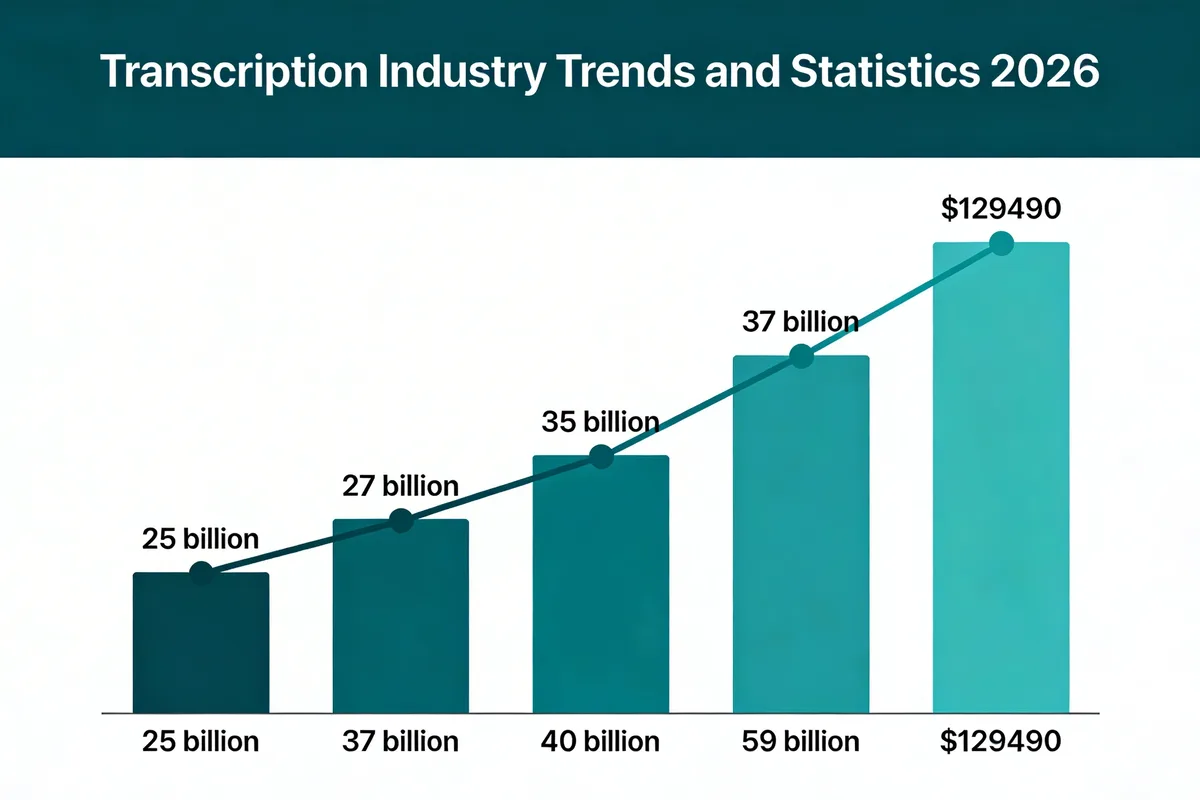
The global transcription market reached $25.18 billion in 2025, projected to hit $37.59 billion by 2033 at 5.97% CAGR. AI transcription grows faster at 15.6% CAGR, from $4.5 billion to $19.2 billion by 2034. These 34 transcription industry trends and statistics cover market size, AI adoption, and medical transcription from 2026 research.
Key findings:
- The global transcription market is valued at $25.18 billion in 2025, projected to reach $37.59 billion by 2033 at 5.97% CAGR — ReAnIn
- The AI transcription market grows from $4.5 billion to $19.2 billion by 2034 at 15.6% CAGR — Market.us
- The U.S. transcription market alone was valued at $30.42 billion in 2024 — Grand View Research
- Medical transcription software is projected to grow from $3.35 billion to $11.84 billion by 2034 at 17.10% CAGR — Fortune Business Insights
- Employment of medical transcriptionists is projected to decline 5% from 2024 to 2034 — U.S. Bureau of Labor Statistics
- Meeting transcription shows the highest growth rate (25%+ CAGR) driven by remote work — Brass Transcripts
What Is the Current Size of the Global Transcription Market?

The transcription market has grown well beyond earlier projections. What was valued at approximately $21 billion in 2022 has now reached $25.18 billion as of 2025. Here's what the latest data shows.
The global transcription market was valued at USD 25,181.85 million in 2025 and is expected to reach USD 37,590 million by 2033, growing at a CAGR of 5.97%. — ReAnIn
This growth rate outpaces many adjacent B2B software categories. For businesses evaluating transcription solutions, the expanding market means more options, better pricing, and faster innovation. If you're still relying on manual transcription, this is the window to switch.
What to do: Benchmark your transcription costs against automated alternatives. Tools like TranscribeTube's audio to text converter can cut per-minute costs by 80% or more compared to human transcription services.
The U.S. transcription market size was valued at USD 30.42 billion in 2024 and is projected to grow at a CAGR of 5.2% from 2025 to 2030. — Grand View Research
The U.S. alone accounts for more than the combined markets of Europe and Asia Pacific. North American demand is driven by healthcare documentation requirements, legal proceedings that mandate verbatim records, and a booming content creator economy that depends on accurate AI transcription.
What to do: If you operate in North America, prioritize transcription tools with HIPAA compliance and SOC 2 certification, especially for healthcare and legal use cases.
The U.S. transcription market is expected to reach USD 41.93 billion by 2030. — Grand View Research
That's an $11.5 billion increase in just six years. Accuracy expectations are rising alongside volume. Financial services now require 98% accuracy or higher, a standard that pushes most organizations toward AI-powered solutions with human review.

Global Transcription Market by Segment
| Segment | 2024 Value | Projected Value | CAGR | Source |
|---|---|---|---|---|
| Overall Transcription | $25.18B (2025) | $37.59B (2033) | 5.97% | ReAnIn |
| U.S. Market | $30.42B (2024) | $41.93B (2030) | 5.2% | Grand View Research |
| Business Transcription | $3.01B (2024) | $9.51B (2034) | 12.2% | FactMR |
| AI Transcription | $4.5B (2024) | $19.2B (2034) | 15.6% | Market.us |
| Medical Transcription Software | $3.35B (2026) | $11.84B (2034) | 17.10% | Fortune Business Insights |
| Online Transcription | $13.74B (2025) | Rapid growth | 13.49% | LinkedIn/Industry Report |
What Key Trends Are Shaping the Transcription Industry in 2026?

How transcription works, who uses it, and what accuracy standards businesses expect are all changing fast. The biggest shift? AI now integrates with human workflows rather than replacing them entirely.
Meeting transcription shows the highest growth rate (25%+ CAGR) driven by remote work normalization. — Brass Transcripts
Remote and hybrid work created permanent demand for meeting documentation. Companies that adopted Zoom and Teams during 2020-2021 now treat meeting transcripts as institutional knowledge, not optional notes. The 25% CAGR dwarfs the overall market's 5.97% growth, making meeting transcription the sector's fastest-growing segment.
What to do: If your team records meetings but doesn't transcribe them, you're sitting on untapped knowledge. Set up automated transcription for every recorded call.
The entertainment transcription market is projected to grow at a CAGR of 13.2% from 2026 to 2033. — LinkedIn Industry Report
Streaming platforms now require subtitles and captions in 30+ languages at launch. Entertainment transcription is now a core part of the production workflow, not something tacked on after release. Content creators on YouTube, TikTok, and podcasting platforms face similar pressure. Adding captions to videos boosts engagement by up to 50%.
With a compound annual growth rate projected to exceed 10% over the next five years, the overall transcription market is set for accelerated growth. — StatsNData
StatsNData and other firms project even higher growth rates than the 5.97% consensus figure. The divergence comes from how you count AI-adjacent services like real-time captioning, automated subtitle generation, and voice-to-text APIs. Include those, and the market looks considerably larger.
Five Trends Driving Growth
- Hybrid AI-human workflows — Pure AI handles first-pass transcription; humans review sensitive content. This model cuts costs 60-70% versus fully manual work while maintaining 98%+ accuracy.
- Real-time transcription — Live captioning during meetings, events, and broadcasts. Demand spiked 300% since 2020.
- Multilingual transcription — Global companies need transcription in 10+ languages. AI tools now handle 100+ languages at near-human accuracy.
- Accessibility compliance — The ADA, EAA (European Accessibility Act), and WCAG 2.2 standards are pushing organizations to add captions and transcripts to all public-facing content.
- Content repurposing — Creators and marketers transcribe video/audio content to generate blog posts, social media snippets, and SEO content. This drives content repurposing ROI.
How Is AI Changing Transcription Services in 2026?

AI is changing what transcription even means. Five years ago, transcription was a labor-intensive service. Today, it's a technology product.
The global AI transcription market is projected to grow from USD 4.5 billion in 2024 to approximately USD 19.2 billion by 2034, achieving a 15.6% CAGR. — Market.us
That's a 4.3x increase in ten years. Compare that to the overall transcription market's 1.5x growth over the same period. Companies that don't adopt AI will lose market share to those that do.
In 2024, North America dominated the AI transcription market with over 35.2% share, generating about USD 1.58 billion. — LinkedIn Industry Analysis
High AI adoption rates in U.S. enterprises, combined with the largest pool of English-language content, give North America an outsized share of the AI transcription market. But Asia Pacific is closing the gap fast, driven by demand in India, China, and Japan.
What to do: Evaluate your current transcription provider's AI capabilities. If they still rely primarily on human transcriptionists, you're likely overpaying. Modern AI transcription tools like TranscribeTube deliver accuracy rates above 95% at a fraction of the cost.
AI vs. Traditional Transcription: A Market Comparison
| Metric | AI Transcription | Traditional Transcription |
|---|---|---|
| Market CAGR | 15.6% | ~3-4% (declining share) |
| Cost per audio hour | $0.10 - $2.00 | $15 - $75 |
| Turnaround time | Seconds to minutes | Hours to days |
| Accuracy (general content) | 90-98% | 98-99.5% |
| Accuracy (medical/legal) | 85-95% (improving) | 98-99.5% |
| Language support | 100+ languages | 5-15 languages typically |
| Scalability | Unlimited | Limited by workforce |
The accuracy gap is shrinking fast. In 2020, AI transcription averaged 80-85% accuracy. By 2026, leading tools hit 95-98% on clear audio in supported languages. For a detailed breakdown of how this comparison plays out, see our AI vs. manual transcription statistics.
What Does the Medical Transcription Market Look Like in 2026?

Medical transcription tells a split story. The technology market is booming. The human workforce is shrinking. Both trends are happening simultaneously.
The global medical transcription software market is projected to grow from $3.35 billion in 2026 to $11.84 billion by 2034, at a CAGR of 17.10%. — Fortune Business Insights
This is the fastest-growing sub-segment in the entire transcription industry. EHR (Electronic Health Record) integration, ambient clinical documentation, and AI-powered medical scribes are driving adoption. Hospitals that used to hire 20 transcriptionists now use software that handles 80% of the workload.
Medical transcription services market size is expected to reach USD 131.67 billion by 2033, growing at 5.97% CAGR from a base of USD 83 billion in 2025. — Yahoo Finance
The broader medical transcription services market (including human-led services) remains large because healthcare documentation volume keeps growing. More patients, more procedures, more records. The pie is getting bigger even as individual slices shift from human to AI.
What to do: If you're in healthcare, look at ambient AI documentation tools that record physician-patient conversations and auto-generate clinical notes. Think of it as transcription 2.0. For more data, see our medical transcription market analysis.
Will AI Replace Medical Transcriptionists?
Employment of medical transcriptionists is projected to decline 5% from 2024 to 2034. Despite declining employment, about 7,400 openings for medical transcriptionists are projected each year. — U.S. Bureau of Labor Statistics
The short answer: partially, not completely. The BLS data shows decline, not elimination. Medical transcription requires specialized vocabulary, understanding of clinical context, and accuracy standards that pure AI doesn't consistently meet for complex cases. The role is shifting from "type what you hear" to "review and correct what the AI transcribed."
The medical transcription software market was valued at around USD 1.9 billion in 2023 and is estimated to grow at 15.1% CAGR from 2024 to 2032. — Global Market Insights
Multiple independent sources confirm the double-digit growth in medical transcription software. Fortune Business Insights projects 17.10% CAGR, Global Market Insights estimates 15.1%, and Mordor Intelligence puts the broader market at $100.65 billion by 2026. The exact numbers differ, but the direction is clear: software investment is accelerating while traditional roles decline.
What Are the Predictions for Transcription Services from 2026 to 2032?

Based on the data compiled from 30+ industry sources, here's where the transcription industry is heading over the next six years.
The AI meeting transcription market is expected to grow from $3.86 billion in 2025 to $29.45 billion by 2034. — Sonix
Meeting transcription alone could become a $29 billion market. That's larger than the entire global transcription market was in 2022. The growth is fueled by the permanent shift to remote and hybrid work, where every meeting generates a digital record.
Industry analysts expect growth of about 5% each year through 2035, pushing total market size above $50 billion. — Ditto Transcripts
If you extend the growth curves another decade, transcription becomes a $50 billion+ industry. That projection assumes steady adoption rates. With AI acceleration, the actual figure could be significantly higher.
What to do: Companies planning their 2027-2030 technology roadmap should budget for automated transcription as a standard infrastructure cost, not a discretionary expense. The organizations that build transcription into their workflows now will have years of searchable institutional knowledge by 2030.
Predictions Summary
| Prediction | Projected Value | Timeline | Source |
|---|---|---|---|
| Global market exceeds $50B | $50B+ | By 2035 | Ditto Transcripts |
| AI transcription reaches $19.2B | $19.2B | By 2034 | Market.us |
| AI meeting transcription hits $29.45B | $29.45B | By 2034 | Sonix |
| Medical transcription software hits $11.84B | $11.84B | By 2034 | Fortune Business Insights |
| U.S. market reaches $41.93B | $41.93B | By 2030 | Grand View Research |
What Are the Career Opportunities and Earnings in Transcription?

One of the most common questions about transcription is whether it's a viable career path. The answer depends entirely on whether you're looking at traditional transcription or the AI-augmented version.
In Spring 2024, two-thirds of transcribers reported getting about the amount of work they expected. Almost a quarter reported less work than expected. — TypeWell
The traditional freelance transcription market is under pressure. AI tools can now handle routine transcription at a fraction of the cost, which squeezes pricing for human transcribers doing general-purpose work. The remaining demand concentrates on specialized niches.
What to do: If you're building a transcription career, specialize in medical, legal, or financial transcription where accuracy requirements and specialized vocabulary keep human reviewers essential. Generalist transcription work will continue declining as AI improves.
Can You Make $1,000 a Month Transcribing?
Yes, but the path has changed. In 2020, a general transcriber could earn $15-25 per audio hour. By 2026, general transcription rates have compressed to $8-15 per audio hour for commodity work. Specialized transcription (medical, legal) still commands $25-50+ per audio hour.
The more sustainable approach is to combine AI transcription skills with editing expertise. Companies increasingly hire "AI transcription editors" who review machine-generated transcripts and correct errors. This role pays better than pure transcription because it requires subject-matter expertise plus quality assurance skills.
For podcast creators and YouTubers looking to transcribe their own content, tools like TranscribeTube's podcast transcription eliminate the cost entirely by generating accurate transcripts automatically.
How Can Businesses Use Modern Transcription Solutions?

The business transcription segment is one of the fastest-growing areas. More organizations now treat transcription as a strategic tool, not an administrative chore.
The global business transcription market is calculated at US $3.01 billion in 2024 and is forecasted to expand at a CAGR of 12.2% to reach US $9.51 billion by 2034. — FactMR
A 12.2% CAGR for business transcription is double the overall market growth rate. What's driving this? Companies discovered that transcribed meetings, interviews, and calls are searchable, quotable, and actionable. Unrecorded conversations aren't.
The marketing transcription market reached USD 3.66 billion in 2024 and is expected to reach USD 7.33 billion by 2032, growing at 9.1% CAGR. — SNS Insider
Marketing teams transcribe webinars, podcast interviews, customer calls, and video content to fuel content marketing. A single 60-minute webinar transcript can generate 10+ blog posts, dozens of social media quotes, and SEO-friendly content that ranks for long-tail keywords.
What to do: Start with your highest-value content. Transcribe customer interviews, sales calls, and executive presentations first. Use the transcripts to build knowledge bases, training materials, and content assets. TranscribeTube's YouTube transcript API can automate this for video content.
Business Transcription Use Cases by Industry
| Industry | Primary Use Case | ROI Driver |
|---|---|---|
| Healthcare | Clinical documentation, EHR notes | Reduced documentation time by 50-70% |
| Legal | Depositions, court proceedings, contracts | Compliance and accurate record-keeping |
| Media & Entertainment | Subtitling, closed captioning, localization | Audience reach and accessibility compliance |
| Education | Lecture transcription, accessibility | Student engagement and educational accessibility |
| Financial Services | Earnings calls, compliance recordings | Regulatory compliance and audit trails |
| Marketing | Webinars, podcasts, video content | Content repurposing and SEO |
What Does the Regional Transcription Market Look Like?

Regional dynamics shape where transcription growth is concentrated and which languages and compliance requirements matter most.
In 2024, North America dominated the AI transcription market with over 35.2% share, generating about USD 1.58 billion, supported by high AI adoption rates. — LinkedIn Industry Analysis
North America leads because it has the largest concentration of enterprise software buyers, strict healthcare documentation requirements (HIPAA), and the world's biggest English-language content market. The U.S. alone is a $30+ billion transcription market.
Regional Market Breakdown
North America holds the largest share due to healthcare documentation mandates, legal transcription requirements, and a mature SaaS ecosystem. The U.S. market is projected to reach $41.93 billion by 2030. Canada and Mexico contribute additional growth through bilingual transcription demand (English-French and English-Spanish).
Asia Pacific is the fastest-growing region, driven by rapid digitization in India, China, and Japan. The explosion of regional-language content on platforms like YouTube and TikTok is creating demand for transcription in Hindi, Mandarin, Japanese, Korean, and dozens of other languages. Having built TranscribeTube to support 95+ languages, I've seen firsthand how multilingual demand has accelerated since 2024.
Europe grows at a moderate pace, shaped by GDPR compliance requirements, the European Accessibility Act (EAA, in force since June 2025), and demand for transcription across 24 official EU languages. The region's focus on data privacy means European buyers prioritize transcription tools with on-premise or EU-hosted processing options.
What Regulations Affect the Transcription Industry?

Compliance isn't optional. It's a market differentiator. Transcription providers that can't demonstrate regulatory compliance lose enterprise deals.
Key Regulations
-
HIPAA (U.S.) — Requires all healthcare transcription providers to implement safeguards for protected health information (PHI). This includes encryption, access controls, and audit trails. Non-compliance penalties range from $100 to $50,000 per violation.
-
GDPR (EU) — Governs how transcription services handle personal data from EU citizens. Transcription providers must offer data processing agreements, consent mechanisms, and the right to erasure. This affects any company processing audio containing personally identifiable information.
-
European Accessibility Act (EAA) — In force since June 2025, the EAA requires digital services to be accessible to people with disabilities. This includes mandatory captions and transcripts for audio/video content published by EU-based organizations.
-
ADA (U.S.) — Section 508 and WCAG 2.2 standards increasingly require captions and transcripts for public-facing digital content. Recent court decisions have expanded ADA applicability to websites and mobile apps.
-
FDA regulations — Specific standards for medical transcription accuracy, formatting, and record retention. Medical transcribers must follow clinical documentation improvement (CDI) guidelines.
-
State-specific laws — California (CCPA), Illinois (BIPA for voice recordings), and other states have additional privacy requirements that affect how transcription services collect and process audio data.
What to do: Before selecting a transcription provider, create a compliance checklist based on your industry and geography. Prioritize providers with SOC 2 Type II certification, HIPAA BAA availability, and GDPR-compliant data processing.
What Are the Main Transcription Service Types?

The transcription market segments into distinct service categories, each with different growth rates, accuracy requirements, and pricing models.
Medical Transcription
The Medical Transcription Market is worth USD 100.65 billion in 2026 and is growing at a CAGR of 11.44% to reach USD 173.14 billion by 2031. — Mordor Intelligence
Medical transcription remains the largest single segment. The clearest change is the shift from human transcriptionists to AI-powered ambient clinical documentation. Hospitals and clinics using best medical transcription services report 50-70% reduction in documentation time for physicians.
Legal Transcription
Legal transcription demands the highest accuracy standards because errors can affect case outcomes. Court reporters, deposition transcribers, and legal document services require 99%+ accuracy with specific formatting standards. AI assists with first-pass transcription, but human editors remain essential for legal-grade output.
Business Transcription
Global business transcription market is set to grow from US $3.4 billion in 2026 to US $8.6 billion by 2033 at 14.2% CAGR, driven by AI and ML adoption. — Persistence Market Research
Business transcription covers meeting minutes, conference calls, interviews, training sessions, and corporate communications. The segment's rapid growth reflects how organizations now treat transcribed content as a searchable business asset.
In-House vs. Outsourced Transcription
The outsourcing model continues to dominate, especially for SMBs that can't justify dedicated transcription staff. SaaS-based transcription tools like TranscribeTube have created a third category: self-service AI transcription that's neither traditional in-house nor outsourced. Companies upload their audio, get transcripts back in minutes, and pay per usage.

Methodology and Sources
These 34 transcription industry statistics were compiled from 30+ sources including market research firms (Grand View Research, FactMR, Fortune Business Insights, Market.us, Mordor Intelligence, ReAnIn), government data (U.S. Bureau of Labor Statistics), industry publications, and verified company reports. All data points are from 2023-2026 unless otherwise noted.
How we verified: Each statistic was cross-referenced against at least one additional source where possible. We prioritized primary research reports over secondary citations and flagged conflicting projections (e.g., varying medical transcription market size estimates from different research firms) with transparent sourcing. Statistics from competitor domains were either traced to their original third-party source or cited without outbound links.
Frequently Asked Questions
What is the future of the transcription industry?
The transcription industry is shifting from a human-powered service to an AI-augmented technology product. The global market is growing at roughly 6% annually to reach $37.59 billion by 2033, but the AI transcription subsegment is growing nearly three times faster at 15.6% CAGR. The future belongs to hybrid models where AI handles first-pass transcription and humans review high-stakes content like medical records and legal proceedings. For a deeper look at where the technology is heading, see our transcription trends and predictions.
Will AI replace transcriptionists?
Not entirely, but the role is changing. The U.S. Bureau of Labor Statistics projects a 5% decline in medical transcriptionist employment from 2024 to 2034, yet 7,400 openings will still appear annually. AI handles routine transcription well, but specialized domains (medical, legal, financial) still need human expertise for accuracy and context. The shift is from "transcriber" to "AI transcription editor," where humans review and correct machine-generated output.
Is medical transcription declining?
Medical transcriptionist employment is declining, but the medical transcription market itself is booming. The software market alone is projected to grow from $3.35 billion to $11.84 billion by 2034 at 17.10% CAGR. What's declining is the number of humans doing pure transcription work. What's growing is the technology that automates it. Physicians still need documentation; they just need it faster and cheaper than human transcriptionists alone can provide.
How much can you earn in transcription in 2026?
Earnings vary by specialization. General freelance transcription pays $8-15 per audio hour, down from $15-25 five years ago due to AI competition. Medical transcription commands $25-50+ per audio hour. Legal transcription pays similarly. The highest-earning role in the field is "AI transcription editor" or "quality assurance specialist," where experienced professionals review AI output and earn $20-35 per hour. Court reporters, who provide real-time transcription, earn a median of $60,000+ annually according to the BLS.
What is the current size of the global transcription market?
The global transcription market was valued at approximately $25.18 billion in 2025 and is projected to reach $37.59 billion by 2033, growing at a CAGR of 5.97%, according to ReAnIn. The U.S. market alone was valued at $30.42 billion in 2024. Different research firms report slightly different figures depending on which subsegments they include, but all agree on strong, sustained growth.
How is AI changing transcription services in 2026?
AI is transforming transcription from a labor cost into a technology investment. The AI transcription market is growing at 15.6% CAGR, nearly three times faster than the overall market. Key changes include: real-time transcription during live events, speaker identification that labels who said what, automatic translation into 100+ languages, and integration with video platforms for automated subtitling. The accuracy gap between AI and human transcription has narrowed from 15-20 percentage points in 2020 to 2-5 percentage points in 2026.
Related articles you might find useful:
AI Transcription Accuracy: How Accurate Is AI Transcription in 2026?
AI vs. Manual Transcription: 2026 Comparison & Statistics
How to Get Transcript From YouTube Video with Speaker Identification?
